K-1 Fiancée & CR-1/IR-1 Spousal Visa: Real Cost, Timeline, and the Questions You’re Actually Asking
k1-cr1-visa-cost-timeline

Bottom line: If you already know you need a K-1 or CR-1/IR-1 visa, you’re past the “which visa” question—now you want specifics. How much does it actually cost? How long will it really take? Does a past denial, a criminal record, or a previous marriage disqualify you? Below are direct answers to the exact questions couples ask us once they’ve identified their visa path, based on real inquiries we receive.

Quick Answers

How much does a K-1 visa cost?

About $3,500 total: $1,595 Olvis fee, $675 USCIS filing fee (https://www.uscis.gov/i-129f), ₱16,430 (≈$265) visa fee, and ₱29,995 (≈$550) medical exam.

How long does a K-1 visa take?

8 to 10 months on average, from filing to your fiancée’s arrival.

What happens if a K-1 visa is denied?

A prior denial doesn’t automatically block a new petition. What matters is understanding the specific reason it happened and making sure the new filing doesn’t repeat it.

Does a criminal record disqualify a K-1 sponsor?

Not automatically. USCIS evaluates the nature, timing, and disposition of the offense. Disclosing it upfront is far less risky than hoping it goes unnoticed.

Can I apply for a K-1 visa after a divorce?

Yes. You’ll need certified divorce or annulment decrees (https://ph.usembassy.gov/faq-immigrant-visa-application-requirements/) for every prior marriage for both parties.

“How much does it cost, and how long does it take?”

This is the single most common question we get once someone knows they need a K-1 or CR-1/IR-1. Here’s the current breakdown for a K-1 fiancée visa:

Timeline: 8 to 10 months on average, from filing to your fiancée’s arrival.

Visa Cost: Around $3,500 total, split between our fee and government fees:

| Item | Amount |

  • | Olvis Assistance Fee | $1,595.00 |
  • | USCIS Filing Fee | $675.00 |
  • | Visa Fee | ₱16,430.00 ($265.00) |
  • | Medical Exam | ₱29,995.00 ($550.00) |

Our fee is one-time—not billed per phone call or per question, which is a common complaint we hear about attorneys unfamiliar with Philippine-specific immigration processes. After your initial consultation, you’ll receive a detailed checklist of what to prepare and an itemized breakdown of every fee involved, so there are no surprises partway through.

“I’ve heard it’s almost impossible to get approved—is that true?”

Short answer: no, but the mistakes that cause denials are real and avoidable. Most failed applications come down to the same handful of issues: incomplete evidence of a genuine relationship, outdated or incorrect forms, or missing documentation the applicant didn’t know they needed. This is process failure, not proof that the visa itself is unrealistic.

We’ve processed over 15,000 K-1, K-2, and spousal visa applications and maintain a 100% success rate—backed by a guarantee: if a case is denied because of a defect in paperwork we prepared, we stand behind it. Every application we submit is reviewed up to five times before it goes out, specifically to catch the errors that commonly cause denials.

“I already had a visa (tourist or otherwise) denied—can I still apply?”

A prior denial — even a recent one — doesn’t automatically disqualify a future K-1 or spousal petition. A tourist visa denial and a fiancée visa petition are evaluated differently; the reasons an embassy officer cites for one don’t necessarily carry over to the other. What matters is understanding *why* the previous application was denied and making sure the new petition doesn’t repeat the same gap. This is exactly the kind of situation worth reviewing individually in a consultation rather than guessing based on general online advice.

“I have a criminal record—does that disqualify me?”

Not automatically. We regularly work with sponsors who have a record—a past offense from years ago, an arrest without conviction, or a sealed juvenile record. USCIS evaluates the nature, timing, and disposition of any offense as part of the background check; it does not mean automatic denial. This is another area where the specifics of your situation matter more than a blanket answer, and it’s worth disclosing up front rather than hoping it goes unnoticed—undisclosed history is a far greater risk to your case than a disclosed one.

“I’ve been divorced (or married multiple times) before—what do I need?”

You’ll need certified divorce decrees (or annulment decrees, for a previously married Filipina partner, since divorce isn’t available under Philippine law) for every prior marriage for both parties. Multiple prior marriages just mean multiple decrees to gather—it doesn’t change your eligibility. The earlier you start collecting these documents, the less likely they become a bottleneck later in the process, since older records can take time to track down.

“Can her children come with her?”

Yes. A stepchild under 21 and unmarried can be included as a derivative beneficiary—through the [K-2 visa](https://www.uscis.gov/family/family-of-us-citizens/visas-for-fiancees-of-us-citizens) in a fiancée case or through a connected petition in a spousal case. If your situation includes children, the most efficient path is filing for the parent and child together from the start rather than adding the child’s petition later.

“Should I just do this myself, or hire an attorney instead?”

Worth being direct about the trade-offs here, since it’s a real decision every “ready-to-move-forward” couple faces.

DIY?

Possible, but the visa process has no tolerance for small mistakes. One incorrect or outdated form can send the whole petition back, costing you the months you already waited.

A US-based immigration attorney?

May not be familiar with Philippine-specific requirements (local document formats, PSA processing quirks, embassy-specific interview patterns) and often bills by the question or the hour.

A Philippines-based specialist?

Works these cases daily and speaks your fiancée’s language directly, tending to catch Philippine-specific issues before they become delays, typically at a flat, one-time fee instead of hourly billing.

There’s no universally “right” answer for every couple—but if your case involves any complication (a prior denial, a criminal record, multiple marriages, stepchildren), that’s usually the point where a specialist’s experience saves more time and money than it costs.

What’s the actual next step?

If you already know which visa you need, the next useful step is a consultation where we review your specific situation—including anything that feels complicated, like a prior denial or a criminal record—and give you a clear checklist and fee breakdown before you commit to anything.

Book a free visa consultation with Olvis now.
Or call toll-free 1-877-226-6751, 10 AM–6 PM daily, direct to our Cebu City office.

Still Weighing It? The Real Concerns, Answered Head-On

“$1,595 feels like a lot on top of government fees—is it worth it?”
Compare it to the alternative: a US attorney unfamiliar with Philippine-specific requirements, often billing hourly per call or question, can cost significantly more over the life of a case—and still miss local details a specialist catches routinely. Our fee is flat and disclosed upfront, covering full paperwork prep, all scheduling, and interview briefing.

“I’ve heard this seldom works out—what makes you confident it’ll work for us?”
“Almost impossible” usually describes avoidable mistakes, not the visa category itself. 15,000+ processed cases and a 100% success rate, backed by a guarantee on our own paperwork, is the actual track record behind that claim.

“How do I know Olvis is legitimate and not just another agency making promises?”
Verifiable specifics: a named person on camera (Mike Tessitore), accreditation with ASIP and Philippine government bodies, and a real Cebu office—not marketing language alone.

“We’re already fairly informed—do we actually need a service, or can we file ourselves at this point?”
Knowing which visa you need is a big first step, but the paperwork itself is where most delays happen—outdated forms, incomplete evidence, missing signatures. If you’re confident in your documentation, a consultation can simply confirm that before you file; it costs nothing to check.

“Her previous visa (or ours) was denied before—does that mean this will fail too?”
Not necessarily, and this is worth taking seriously rather than assuming the worst. A prior denial has a specific, identifiable cause in nearly every case—reviewing what happened is exactly how we prevent it from repeating.

Real Words From Couples Who’ve Been Through This
USA spousal visa agency in the Philippines

“I told Mike that I would not need his services, as I am an attorney practicing in Los Angeles and could do it myself… Mike showed me that some of the forms they had given me were the wrong ones and others were outdated. Indeed, after he further explained the whole visa procurement process to me in detail, I realized that I really needed help.” — Joseph and Roma

“Mike, ‘Thank you’ for assisting me here in the US; no immigration attorney can even come close to all the support and personal attention you have given me. My wife is with me now and doing well.” — Ronald & Belinda

“She was the only one of two who had all her documentation and was actually prepared for the interview… The help and preparation they supplied made the process fast and pain-free.” — Richard and Indira Calkins, Orange County, California

Where to Go Next

Still not sure which visa applies to your specific situation? Start with You Want to Bring Your Filipina Partner Home to the US — But Which Visa Actually Fits Your Situation?

Already comparing us against another agency or an attorney? K-1 Visa Scheduling: How Olvis Books Your Interview, Biometrics, and Medical Exam

Olvis Is a Proud Member / Affiliate Of

– ASIP — American Society of Immigration Professionals

– American Society of Immigration Professionals 

– Department of Tourism, Philippines

– Philippine Retirement Authority (est. 1985)

– Cebu Chamber of Commerce & Industry (est. 1903)

– Love The Philippines—Philippine Department of Tourism

– National Privacy Commission, Philippines

– Cebu Council of Lions Clubs Presidents—Lions Clubs International

Sources & Further Reading

– Official Government Source: [Form I-129F, Petition for Alien Fiancé(e) — USCIS](https://www.uscis.gov/i-129f)

– Official Government Source: [Nonimmigrant Visa for a Fiancé(e) (K-1)—U.S. Department of State](https://travel.state.gov/content/travel/en/us-visas/immigrate/family-immigration/nonimmigrant-visa-for-a-fiance-k-1.html)

– Official Government Source: [Immigrant Visa for a Spouse of a U.S. Citizen (IR-1/CR-1) — U.S. Department of State](https://travel.state.gov/content/travel/en/us-visas/immigrate/family-immigration/immigrant-visa-for-spouse.html)

– Official Government Source: [Immigrant Visa Document Requirements FAQ — U.S. Embassy in the Philippines](https://ph.usembassy.gov/faq-immigrant-visa-application-requirements/)


This article reflects USCIS and Department of State guidance and Olvis’s current service fees as of 2026. Every case is different—the answers above are common patterns, not a substitute for an individual case review.
How to Vet a Visa Consultant in the Philippines Before You Commit?

travel-agency-cebu-visa-proccessing

Bottom line: If you’re reading this because you saw Mike Tessitore in an interview—on The Filipina Pea’s channel, Patreon, or elsewhere—and you’re now deciding whether Olvis is actually the right fit versus another agency, an attorney, or doing it yourself, this post is for you.

Here’s exactly what to check, because “I saw them on YouTube” is a starting point for trust, not a substitute for verifying it. 

Quick Answers

Should I use a visa agency or hire an immigration attorney instead?

An attorney unfamiliar with Philippine-specific requirements often bills hourly and can miss local document details. A specialist working these cases daily tends to charge a flat fee and catch those details before they cause delays.

How do I know if a visa consultant in Cebu is legit?

Check for a named, findable person on camera, a physical office, and verifiable third-party accreditations, not just marketing claims.

What makes a visa agency trustworthy?

A guarantee on their own paperwork, a real track record with numbers attached, and recognized professional affiliations, not just self-described expertise.


“I have a gut feeling you’re more reliable than most—but how do I actually verify that?”

A good instinct is a fine starting point. Here’s what to check beyond it:

Is there a real, named person behind the business, on camera, answering real questions?
Not a logo, not a stock photo team page—an actual person you can watch explain the process and respond to specific situations.


Do they have a track record with a number attached to it, not just a claim?
Olvis has processed 15,000+ K-1, K-2, and spousal visa applications since 1985, backed by a guarantee: if a case is denied because of a paperwork defect on our end, we stand behind it.


Are they affiliated with recognized organizations, not just self-described as “experts”?
Olvis is a member of the American Society of Immigration Professionals (ASIP) and is registered with the Philippine Department of Tourism, the [Philippine Retirement Authority](https://pra.gov.ph), the Cebu Chamber of Commerce & Industry, and the [National Privacy Commission—verifiable affiliations, not marketing copy.


Do they have a physical, findable office, or only a website and a phone number?
Olvis operates from Ayala Mall, Cebu City—an actual location you or your fiancée can visit. None of this replaces your own judgment. It’s meant to give you concrete things to check instead of relying on a gut feeling alone—for us or for anyone else you’re considering.

“I’m shopping around—how do I compare you against another agency?”

Fair question, and worth asking of anyone you’re considering, not just us. A few things worth comparing directly:

Flat fee vs. hourly billing
Some providers, especially US-based attorneys unfamiliar with Philippine-specific requirements, bill per call or per question. Olvis charges one flat assistance fee, disclosed upfront.


Philippine-specific experience vs. general immigration experience.
A US attorney may know immigration law broadly but not the local specifics—PSA document formats, embassy-specific interview patterns, and Philippine annulment requirements for previously married partners. A Cebu-based specialist working these cases daily tends to catch these details before they cause delays.

What’s actually included?
Ask any provider directly: do they prepare and organize all paperwork, schedule your fiancée’s biometrics and interview, and brief her before the embassy interview—or do you still have to handle parts of it yourself? Get this in writing before you commit, from whoever you choose.

If another provider gives you clear, specific answers to these same questions, that’s a good sign regardless of who they are. Vague answers, pressure to decide immediately, or no clear breakdown of what’s included are the actual red flags to watch for—more useful than which agency name you’ve heard of.

“Is there a real difference between the free consultation and paying you?”

The free consultation is where we (or, frankly, whoever you’re considering) should be able to tell you three things without asking for payment first: which visa applies to your specific situation, what it will likely cost given your case’s specifics, and what documents you’ll need to start gathering. If a provider won’t give you that much before you pay, that’s worth noticing.

“My partner was denied a visa before—does that make me a bad candidate for anyone I work with?”

No—but it does mean you need someone who will ask why the prior denial happened before filing anything new, not someone who treats every case identically. This is one of the clearest situations where a general online guide or a generic agency process falls short: a repeated mistake is far more damaging than the original denial.

What to actually do next

Whether you choose Olvis or someone else, the right next step is the same: a real conversation where someone reviews your specific situation and gives you a clear, written breakdown of cost, timeline, and what’s included—before you pay anything. That’s what our free consultation is built to do.

Book a free visa consultation with Olvis now.
Or call toll-free 1-877-226-6751, 10 AM–6 PM Manila Time; the line is open daily, including Sundays and holidays. It’s a direct line from Las Vegas, Nevada, to our Cebu City office. So this isn’t your annoying salesperson.

The Top 5 Hesitations Everyone Has Before Choosing a Consultant

“The fee feels high compared to just doing it myself.”
It’s not just paperwork prep you’re paying for—it’s the total value: scheduling, interview briefing, and a guarantee on our own document defects. Compare the full scope of what’s included against any other option’s price, not just the sticker number.

“I’ve heard success stories, but will it actually work for my case?”
Ask any provider for real, specific numbers—not just testimonials. Ours: 15,000+ processed cases, 99% success rate, backed by a written guarantee. If your visa is denied because of our mistake, we’ll refile it at no additional cost.

“I don’t fully trust an agency I only know from a YouTube video.”
That’s the right instinct to have, and it’s exactly what this article walked through—verify the named person, the accreditations, and the physical office, for us or for anyone else.

“Maybe I don’t need an agency at all—my case seems straightforward.”
Straightforward cases are exactly where DIY works best. The value of a specialist shows up when something isn’t straightforward—a document oversight, a scheduling conflict, or a detail specific to Philippine paperwork that a general guide won’t mention.

“I (or my partner) already had a visa issue before—will that follow us here?”
A past denial or issue doesn’t disqualify future success, but it does mean whoever you work with needs to understand exactly what happened the first time. That’s a direct question worth asking any provider before you commit.

Real Words From Couples Who’ve Been Through This

olvis visa services in Cebu

“Mike, ‘Thank you’ for assisting me here in the US; no immigration attorney can even come close to all the support and personal attention you have given me. My wife is with me now and doing well.” — Ronald & Belinda

“I told Mike that I would not need his services, as I am an attorney practicing in Los Angeles and could do it myself… after he further explained the whole visa procurement process to me in detail, I realized that I really needed help.” — Joseph and Roma

“She was the only one of two who had all her documentation and was actually prepared for the interview… The help and preparation they supplied made the process fast and pain-free.” — Richard and Indira Calkins, Orange County, California

Where to Go Next

Already decided and just need next steps? K-1 Visa Scheduling: How Olvis Books Your Interview, Biometrics, and Medical Exam

Olvis Is a Proud Member / Affiliate Of

– ASIP — American Society of Immigration Professionals

– American Society of Immigration Professionals 

– Department of Tourism, Philippines

– Philippine Retirement Authority (est. 1985)

– Cebu Chamber of Commerce & Industry (est. 1903)

– Love The Philippines—Philippine Department of Tourism

– National Privacy Commission, Philippines

– Cebu Council of Lions Clubs Presidents—Lions Clubs International

Sources & Further Reading

Official Government Source: [Philippine Retirement Authority] (https://pra.gov.ph)

Official Government Source: [National Privacy Commission, Philippines] (https://privacy.gov.ph)


This article is for general informational purposes. Every provider and every case is different—the questions above are meant to help you evaluate any visa consultant, not just Olvis, before you commit.

K-1 Visa Scheduling: How Olvis Books Your Interview, Biometrics, and Medical Exam

us-ir-1-cr-1-spousal-visa-application-cebu-philippines

Bottom line: If you’ve already spoken with Mike, you’re mid-process with us, you’re a returning client, or you’re simply ready to start — you don’t need more education on visas. You need clear next steps.

Here’s exactly how to schedule, what to expect if you’ll be in Cebu, what to do if you’ve worked with us before, and how to reach us once you’re already in the process.

Quick Answers

How do I schedule a US visa appointment with Olvis?

Call toll-free 1-877-226-6751, 10 AM–6 PM daily, or book through our contact page. Have your name, your fiancée’s or spouse’s name, and your rough timeline ready.

What happens in a K-1 visa interview?

A review of your DS-160, questions on your relationship history, a check of your medical exam results, and in 2026, expect questions on social media and criminal history declarations.

Can returning Olvis clients get help again?

Yes. Mention that you’re a returning client and roughly when you last worked with us so we can pull your history faster.

“I’ve already spoken with Mike — how do I actually book my appointment?”

If you’ve had an initial conversation and you’re ready for the next step, tell us three things when you reach out: your name (and your fiancée’s or spouse’s, if known), whether you’re contacting us by phone or in person, and your general timeline or travel dates if you have them. That’s enough for us to get you on the calendar — you don’t need to re-explain your whole situation from scratch.

Call toll-free 1-877-226-6751

10 AM–6 PM daily, or book directly through our homepage.

“I’ll be in Cebu — can we meet face-to-face?”

Yes, and this is the preferred option if your travel dates allow it. Our office is at Ayala Mall, Cebu City, Level 4. If you know your dates in the Philippines, send them to us in advance — even a rough window — so we can hold a slot for an in-person consultation rather than trying to schedule once you’ve already landed. Couples who are both in Cebu at the same time often use this trip to complete document collection and initial paperwork review in a single visit.

“I’m already mid-process — how do I get an update or reach Mike about my specific case?”

If you’ve already signed up and your case is active, the fastest way to reach us about a specific filing (an I-129F already submitted, a scheduled interview, or a document we’re waiting on) is to reference your name and the stage you’re at when you call or email — this routes you to the right person faster than starting a new general inquiry. If it’s genuinely urgent (an upcoming interview date, a document deadline), say so directly; we prioritize active-case questions over new inquiries.

“I used Olvis years ago — can you help again, or do I need something like a waiver?”

Yes, and this comes up more often than you’d think—clients who worked with us years ago, sometimes for their own case, now returning to help a family member or to handle a follow-on issue like a waiver. Being a returning client actually helps: we likely already have background on your prior case, which can shorten the time needed to understand your new situation. Reach out the same way as a new inquiry, but mention that you’re a returning client and roughly when you last worked with us—it helps us pull relevant history faster.

“What actually happens right after I sign up?”

Once you commit, here’s the sequence: we collect biographical information from both you and your fiancée or spouse to determine the exact documents needed for your specific case, then send you a checklist and begin paperwork preparation.
From there, we handle scheduling your fiancée’s or spouse’s biometric appointment, medical exam, and embassy interview and provide a full briefing session before the interview covering likely questions and what to expect. You’re not left to figure out timing on your own at any point — you’ll know what’s next before you need to ask.

“Before I commit — can you confirm the cost one more time?”

Reasonable to want this in writing before moving forward. For a K-1 Fiancée Visa, current pricing runs approximately $3,500 total: our $1,595 flat assistance fee, plus government fees (USCIS filing fee $675, visa fee ≈$265, medical exam ≈ $550).
If your situation involves anything non-standard—a prior marriage, a previous denial, stepchildren — we’ll confirm any case-specific cost adjustments during your consultation, not after you’ve already paid.

Ready when you are

Book your consultation with Olvis now. Or call toll-free 1-877-226-6751, 10 AM–6 PM daily. If you’re a returning client or already mid-process, mention that when you reach out so we can pull up your history right away.

Before You Confirm — Last Questions, Answered

“The total cost still feels like a lot to commit to.”
Weigh it against the full scope: complete paperwork handling, all scheduling, and interview prep—versus the time and risk of managing all of it yourself while also working, traveling, and coordinating across two countries.

“What if my case doesn’t go as smoothly as the testimonials suggest?”
Every case gets a specific review of what could complicate it—prior marriages, stepchildren, past issues—before filing, not after. That’s what the consultation and biographical intake step are for.

“I want to be sure this is really Olvis and not just a name I remember.”
If you’ve spoken with Mike before or worked with us previously, say so when you reach out—we can verify your history and pick up where things left off rather than starting over.

“I’ve come this far—do I still need to go through an agency instead of finishing this myself?”
If you’re mid-process already, switching to DIY partway through usually costs more time than it saves—we already have your case context and next steps ready.

“We had a setback before (a denial, an unused prior petition)—can this actually still work?”
Yes, and this is common among returning clients specifically. A prior issue is context we factor into your renewed filing, not a reason to start from zero with doubt.

Real Words From Couples Who’ve Been Through This

olvis-usa-fiancee-visa-free-consultation-jpg

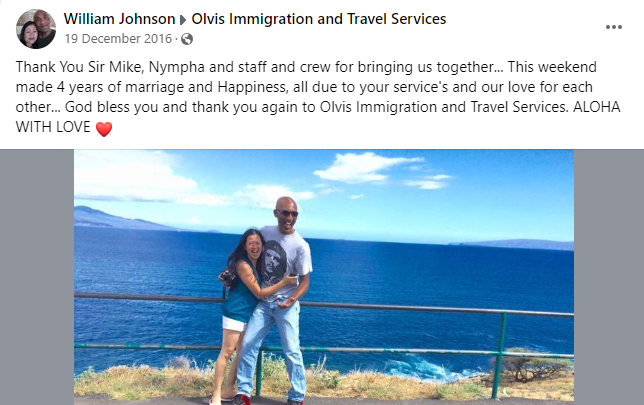
“Thank You Mike, Nympha and staff and crew for bringing us together… This weekend made 4 years of marriage and happiness, all due to your service and our love for each other.”—William Johnson

“Four months after my application with Olvis was filed with the USCIS, my fiancée was on a plane to the United States sitting right next to me.”— Daniel Jobrack

“Mike, ‘Thank You’ for assisting me here in the US, no immigration attorney can even come close to all the support and personal attention you have given me. My wife is with me now and doing well.” — Ronald & Belinda

Where to Go Next

Still comparing your options before committing? Read K-1 Visa Rules Just Got Stricter. Here’s What Actually Changed [2026 Updates]

Olvis Is a Proud Member / Affiliate Of

– ASIP — American Society of Immigration Professionals

– American Society of Immigration Professionals 

– Department of Tourism, Philippines

– Philippine Retirement Authority (est. 1985)

– Cebu Chamber of Commerce & Industry (est. 1903)

– Love The Philippines — Philippine Department of Tourism

– National Privacy Commission, Philippines

– Cebu Council of Lions Clubs Presidents — Lions Clubs InternationaL

Sources & Further Reading

Official Government Source: Immigrant Visas Process Overview — U.S. Embassy in the Philippines (https://ph.usembassy.gov/immigrant-visas-process/)

Official Government Source: Important Visa Information — U.S. Embassy in the Philippines (https://ph.usembassy.gov/important-visa-information/)


This article is for general informational purposes. Fees, timelines, and processing steps reflect current 2026 practice and may change — your consultation will confirm the specifics for your individual case.

K-1 Visa Rules Just Got Stricter. Here’s What Actually Changed [2026 Updates]

Most K-1 fiancée visa denials trace back to one of seven avoidable mistakes: an undisclosed old arrest, a photocopied divorce decree instead of the original, weak proof of an ongoing relationship, a missed FBI clearance, locked-down social media accounts, a missing document at the embassy interview, or trying to handle a complicated case alone. Every one of these gets caught. None of them has to end your case if you catch it first.

The rules changed hard over the last two years. Biometrics and the embassy interview are now separate appointments. Missing documents mean no interview at all, not a reschedule on the spot. Visa applicants list every social media handle on their application, with privacy-setting requirements expanding by category.

This post walks through the traps that actually cost people their fiancée’s visa, drawn straight from 40 years of case experience, so you and anyone you know going through this can skip the pain. Or watch our latest collaboration with the Filipina Pea YouTube page here.

Quick Answers

What income do I need to sponsor a K-1 fiancée visa?

Your income needs to meet 100% of the federal poverty guideline for your household size on Form I-134, the Affidavit of Support. For 2026, that’s $21,640 for a household of two in the 48 contiguous states [1].</sup> If your income falls short, a joint sponsor’s or a household member’s income can cover the shortfall.

How long does the K-1 visa process take right now?

Current cases run 10 to 18 months on average from filing to your fiancée’s arrival, with complex cases stretching to 24 to 36 months. Which National Visa Center staffer and which embassy officer your file lands with play a real role too, and that part isn’t something you get to predict or influence.

What if I have an old or expunged criminal record?

You disclose it anyway. Expunged doesn’t mean erased in USCIS’s eyes. If a court can’t produce the record, you need a notarized statement from the courthouse confirming that. Leaving it off the application, even something 40 years old, reads as fraud if the government finds it, and it usually finds it.

Does my fiancée’s social media get checked?

Yes. Every K-1 applicant lists social media usernames and handles for each platform used, directly on Form DS-160 [3].</sup> Recent State Department expansions have also required some visa categories to set profiles to public for consular review, so confirm the current requirement for your specific case before the interview.

What happens if I’m missing a document at my embassy interview?

You don’t get the interview. The old system let you go home, get the missing document, and reschedule the same appointment. The current rule is stricter: missing documents mean automatic rescheduling, and you go through biometrics again before the new interview date.

The Criminal Record Trap: Why Expunged Doesn’t Mean Erased

Disclose every arrest and conviction on your application, no matter how old or how minor it seemed at the time. USCIS finds records that courts told you were gone.

A conviction from decades ago, even one you paid a fine for and had expunged, still needs to be reported. If the courthouse genuinely can’t locate the file, get a notarized letter from the court confirming that. What you can’t do is decide on your own that something is too old or too small to matter. Cases with multiple convictions, including drug offenses, have been approved when the applicant disclosed everything up front. Cases with a single hidden record have collapsed when the government catches the omission later and treats it as fraud, which is far harder to recover from than the original offense.

The same standard applies to your fiancée. She needs a police clearance from the Philippines, and it needs to be genuine, not altered or forged in any way.

Original Divorce Decree: Why a Photocopy No Longer Works

If you’ve been divorced, you need the original divorce decree, signed by the judge, with the embossed court seal, not a scanned copy or a photocopy you made years ago. That standard used to be looser. It isn’t now.

This gets complicated with multiple marriages. A short marriage from decades back that ended quietly still counts. You need documentation for every one of them, even a marriage that lasted a matter of days when you were a teenager. If a courthouse can’t locate that old record, get a notarized statement confirming there’s no record on file. Skipping a marriage because you assume it won’t surface is one of the fastest ways to turn a routine case into a fraud investigation.

Proving a Real Relationship: What Actually Counts as Evidence

Show ongoing, substantive communication with your fiancée over time, not just photos from a single trip. Most K-1 denials come down to a thin paper trail, not a fake relationship.

Print every message thread: Messenger, WhatsApp, email. Handwritten letters used to be the gold standard; now embassy officers expect printed digital conversations instead, since almost nobody writes physical letters anymore. Phone records showing you called each other aren’t enough on their own, since a log doesn’t prove what was said. The conversations need real content: plans, daily life, the kind of exchange that shows two people actually building something together. From the time you file the petition, expect at least 7 months of this kind of documented contact before your case moves forward.

The Three Interviews You Didn’t Know About

Your fiancée goes through three separate interviews, not one: a medical exam, the embassy interview, and a Commission on Filipinos Overseas (CFO) interview [4].</sup> Missing or failing any one of them stalls the whole case.

The medical exam includes a physical check and, depending on what the physician observes, a psychiatric evaluation. The embassy interview is the one most people picture: a consular officer assessing whether the relationship is genuine and whether the paperwork holds up. The CFO interview is specific to the Philippines and exists to confirm your fiancée understands what she’s agreeing to and knows how to reach help if the relationship turns dangerous after she arrives. It’s a real government safeguard, not paperwork theater, and skipping preparation for it is a common reason Filipino fiancées get delayed at the last stage.

FBI Clearance: The Requirement Most Petitioners Don’t See Coming

You, the U.S. petitioner, now need an FBI clearance in addition to your local police clearance. This is a newer addition to the process and catches most people off guard, since it’s easy to assume your existing clearances already cover it.

Getting an FBI clearance takes real lead time. Start this early rather than treating it as a last-minute item once your embassy interview date gets set.

Social Media Privacy: What Changed and Why It Matters

List every social media handle you and your fiancée use, across every platform, on Form DS-160 [3].</sup> This applies to both people in the relationship, not just your fiancée, and covers accounts you no longer actively use.

The disclosure step exists for screening: consular officers check for red flags, like evidence of another relationship or content that contradicts the story in your application. Confirm the current privacy-setting requirement for your specific case before the interview, since State Department rules on this have expanded in recent years and continue to shift by visa category. If your fiancée keeps a locked-down account out of habit, walk her through what disclosure actually involves early, so it isn’t a surprise sprung on her days before an interview.

Missing Documents = No Interview, Not a Reschedule

Bring every required document to the embassy interview, complete and correct, the first time. The old process let you show up short a document, get sent home, and come back once you found it. That flexibility is gone.

Under the current rule, an incomplete file means you don’t get the interview at all. You go back through biometrics before a new appointment gets scheduled, adding weeks or months to a process that already runs 10 to 18 months at minimum. A checklist built from real cases, reviewed before the appointment, catches this before it costs you a rescheduling cycle.

Should You DIY, Hire a US Attorney, or Work With a Local Visa Consultant?

Handling it yourself

Filing your own K-1 petition is legal, and some petitioners do it successfully. The risk sits in the details: a single wrong or outdated form, a missed disclosure, or an incomplete relationship file returns your whole petition and costs you months. One Olvis client, a practicing attorney in Los Angeles, assumed he’d handle his own paperwork until he found out some of the forms the embassy gave him were outdated or simply wrong.

Hiring a US-based immigration attorney

A US attorney brings legal training, but most aren’t specialists in Philippine-specific requirements: the CFO interview, local police clearance procedures, or how Philippine courts issue original divorce records. Attorney fees also tend to run high, with additional charges for phone consultations.

Working with a local visa and immigration consultant

A consultant based in the Philippines, working K-1 and K-2 cases specifically, brings familiarity with both sides of the process: US immigration requirements and the Philippine bureaucratic steps (CFO, local police clearance, document authentication) that a US-only attorney rarely handles directly. Language support matters too, since a language barrier during interview prep creates real risk of miscommunication.

Common Concerns, Addressed Directly

“This is going to cost too much.” Compare the cost of professional help against the cost of a returned petition: months of delay, a second full round of biometrics, and the emotional toll of another wait. A single paperwork mistake, caught late, usually costs more in lost time than the fee for getting it reviewed the first time correctly.

“I’ve heard bad things about visa agencies, or tried one before, and it fell apart.” That happens, and it’s a fair concern given how many document prep services exist with no real accountability. Ask any consultant directly: what happens if the visa gets denied? A firm confident in its process backs that confidence with a guarantee, not just reassurance.

“My case is complicated. Will this even work for me?” Cases with multiple past marriages, old criminal records, or prior visa denials get approved regularly, as long as everything gets disclosed honestly and documented properly from the start. The failures come from hiding something, not from having a complicated history.

“I don’t trust a company I found online.” Check for verifiable affiliations: real professional memberships, a physical office address, named staff you can call directly. A company with nothing to verify beyond a website is a red flag in an industry with real fraud risk.

“I don’t actually need help. I can handle the forms myself.” Maybe you can. The forms themselves aren’t the hard part. Knowing which document a Philippine courthouse will actually issue, what an embassy officer looks for in relationship evidence, and how to prep your fiancée for three separate interviews is where DIY cases tend to lose months.

One honest note: this kind of service isn’t the right fit for every situation. Olvis works with couples who are transparent and building a genuine, long-term relationship. It doesn’t support applications built on hidden facts or a relationship that isn’t real, and no legitimate consultant should promise to help you hide something from an immigration officer.

Real Words From Couples Who’ve Been Through This

Richard and Indira Calkins, of Orange County, California, watched ten fiancées get interviewed at the Manila embassy the same day as Indira. Only two of the ten showed up with complete documentation and were actually ready. Indira was one of them, and her interview went smoothly because of it.

“𝐒𝐡𝐞 𝐰𝐚𝐬 𝐭𝐡𝐞 𝐨𝐧𝐥𝐲 𝐨𝐧𝐞 𝐨𝐟 𝐭𝐰𝐨 𝐰𝐡𝐨 𝐡𝐚𝐝 𝐚𝐥𝐥 𝐡𝐞𝐫 𝐝𝐨𝐜𝐮𝐦𝐞𝐧𝐭𝐚𝐭𝐢𝐨𝐧 𝐚𝐧𝐝 𝐰𝐚𝐬 𝐚𝐜𝐭𝐮𝐚𝐥𝐥𝐲 𝐩𝐫𝐞𝐩𝐚𝐫𝐞𝐝 𝐟𝐨𝐫 𝐭𝐡𝐞 𝐢𝐧𝐭𝐞𝐫𝐯𝐢𝐞𝐰…”“I am glad to say Olvis Immigration & Travel Services has helped me and my Fiancé with her K1 Fiancé Visa, and everything went smoothly. Out of the 10 ladies interviewed at the U.S. Embassy in Manila for their K1 Fiancé Visa on the day of my fiancé’s appointment. She was the only one of two who had all her documentation and was actually prepared for the interview.

Dan Borden credits the difference to preparation. Once his fiancée’s paperwork was organized properly ahead of time, she went into her interview without nerves and got through it cleanly.

“The call came the next afternoon and by Sunday we were 35,000 feet and on our way to San Francisco and the beginning of our new life.”

Joseph, a practicing attorney in Los Angeles, assumed his legal background meant he didn’t need help. He brought his own forms to double-check a few questions, and found that some of what the embassy had given him was outdated or simply incorrect. He ended up grateful for the second set of eyes on his paperwork.

“I told Mike that I would not need his services, as I am an attorney practicing in Los Angeles and could do it myself, but that I had several questions about the forms. Mike said that he would be happy to assist in any way that he could, so I brought out the forms that the Embassy had provided…Mike showed me that some of the forms they had given me were the wrong ones and others were outdated. Indeed, after he further explained the whole visa procurement process to me in detail, I realized that I really needed help. Again, my sincere gratitude and thanks to you and your staff for the excellent professional and courteous service you provided us throughout the entire process.”

Where to Go Next

Not sure yet whether K-1 is even the right visa for your situation, engaged versus already married, kids in the picture or not? Read Which US Visa Do I Need: Fiancée or Spouse? first to confirm you’re on the right track before applying anything in this post to your case.

Sources & Further Reading

  1. USCIS I-864P, HHS Poverty Guidelines for Affidavit of Support — Official Government Source. Basis for the income threshold figures cited above.
  2. Nonimmigrant Visa for a Fiancé(e) (K-1) — U.S. Department of State — Official Government Source.
  3. DS-160: Online Nonimmigrant Visa Application — U.S. Department of State — Official Government Source. Confirms the DS-160 applies to K visa applicants and requires social media handle disclosure.
  4. Commission on Filipinos Overseas — Official Government Source (Republic of the Philippines). Background on the CFO’s role and its Guidance and Counseling Program for Filipinos marrying foreign nationals.
  5. Visas for Fiancé(e)s of U.S. Citizens — USCIS — Official Government Source.

Olvis Immigration and Travel Services is a proud member and affiliate of:

  • ASIP — American Society of Immigration Professionals
  • Department of Tourism, Philippines
  • Philippine Retirement Authority (est. 1985)
  • Cebu Chamber of Commerce & Industry (est. 1903)
  • Love The Philippines — Philippine Department of Tourism
  • National Privacy Commission, Philippines
  • Cebu Council of Lions Clubs Presidents — Lions Clubs International
  • Rotary Club of Cebu West

Ready to find out where your case actually stands?

Book a free consultation with the Olvis team and get a clear read on your specific situation, your documents, and your timeline before you file anything.

Meet the Olvis team today.


This post gives general information about the K-1 fiancée visa process as of 2026. Fees, processing times, and specific document requirements change. Verify current requirements at uscis.gov and travel.state.gov before filing.

You Want to Bring Your Filipina Partner Home to the US — But Which Visa Actually Fits Your Situation?

fiancee visa immigration agency in Cebu City- Olvis

Bottom line: If you’re reading this, you probably already know you want your partner with you in the US. What you might not know yet is which visa applies to your exact situation — engaged but haven’t met in person, already married, bringing her kids too, dealing with a medical condition, or untangling a past immigration issue.

Below are the real situations couples bring to us most and the visa path that actually fits each one.

Quick Answers  

“What are K-1 fiancee visa requirements? ”

You’re a US citizen, both of you are legally free to marry, you’ve met in person within the last 2 years, and you intend to marry within 90 days of her arrival.

“Do I need a K-1 or a CR-1/IR-1 visa? ”

Engaged and not yet married means K-1. 

Already married means CR-1/IR-1, regardless of how recently you married.

“Can children come on a K-1 visa?”

A child under 21 and unmarried qualifies for a K-2 visa alongside the parent’s K-1.

“Does a past visa overstay disqualify a K-1 petition? ”

Not necessarily or automatically. It changes the strategy and needs an individual case review before filing.

“I don’t know which visa I need.”

This is the question we hear most, word for word. The answer comes down to one thing: 

Are you engaged or already married?

Here’s the distinctions: 

  • Engaged, not yet married → You will need a K-1 Fiancée Visa. 

It lets her enter the US to marry you, with a 90-day window to do so after arrival.

  • Already married → You need a CR-1/IR-1 Spousal Visa instead. 

There’s no “fiancée visa for married couples”—the K-1 category legally requires you to still be unmarried when you file.

If you’re not sure which bucket you’re in yet — for example, you’re planning to get engaged on an upcoming trip — that’s fine. The visa decision doesn’t need to happen until you know the answer to that one question.

“We haven’t met in person yet — can we still start?”

Several couples come to us mid-planning: tickets booked, trip scheduled, but the meeting hasn’t happened yet. So here’s the rule that matters: the K-1 visa legally requires the couple to have met in person, at least once, within the two years before filing. Please take note that a video-chat relationship — even a long one — doesn’t satisfy this requirement. 

But that doesn’t mean you’re stuck waiting indefinitely. Many of the couples we work with are exactly where you might be right now: relationship building over months of calls and messages, a trip already planned, and engagement expected during or shortly after that visit. The paperwork can be prepared in parallel — you don’t have to wait until you’re back home to start getting organized.

Client testimonial with Olvis visa - William Johnson.

“We already got married — now what?”

If the wedding already happened — in the Philippines, in the US, and it’s recognized in both countries — you’re on the CR-1/IR-1 spousal visa track, not the K-1. This applies whether you married recently or you’ve been married for a while and are only now ready to bring her home.

One detail that trips people up: if you married online or in a jurisdiction with different marriage laws, confirm the marriage is recognized as legally valid for immigration purposes before filing — this is worth a quick check before anything else moves forward.

“She has children from a previous relationship — can they come too?”

Yes — this is one of the most common situations we see, and it’s very solvable. A child under 21 and unmarried can be included as a derivative beneficiary.

  • On a K-1 case, this is the K-2 visa for the child.
  • On a CR-1/IR-1 case, the child follows through with a separate but connected petition

The key is starting both petitions together, not sequentially — filing for the parent first and “adding” the child later creates delays that are easy to avoid by planning for both from day one.

“A medical condition or disability limits my ability to travel.”

We’ve worked with clients who are disabled veterans, have medical conditions that restrict air travel, or otherwise can’t easily make repeated trips to the Philippines. This does not disqualify you from sponsoring a fiancée or spouse visa.
However, it does change how you’ll want to plan the required in-person meeting and any travel-dependent steps — worth flagging early in a consultation so the process is built around what’s actually feasible for you, not a generic timeline.

“My partner overstayed a visa, or there’s a past immigration issue.”

A prior visa overstay, a previous denial, or an existing fine doesn’t automatically end the possibility of a future petition — but it does change the strategy. These cases need to be evaluated individually; general online guidance often doesn’t account for how a specific prior issue interacts with a new petition. If this applies to you, this is exactly the kind of situation worth a direct conversation before filing anything.

“How long does this actually take, and when should I start?”

Most couples ask some version of this once they’ve decided to move forward. As a general planning range, a K-1 case typically runs 10-18 months from filing to your fiancée’s arrival in the US, but in some cases, it can be 24-36 months. While a CR-1/IR-1 spousal case runs on a similar or slightly longer timeline. 

A Question We Get Asked a Lot Too

“Hi Olvis team, I just want to ask regarding your visa assistance. If we avail your service, kayo na po ba ang maghahandle ng buong visa process, including preparing and organizing the documents, forms, and evidence/proofs that we need to submit? Or may mga documents po na kami pa rin ang kailangang mag-prepare and edit ourselves? Also, kayo na rin po ba ang mag-guide sa amin from the beginning until the interview/visa decision? Thank you po!”

Here’s the full picture, using the K-1 Fiancé Visa as the example:

Processing Time: 8 to 10+ months on average.

  Item Who Pays   Amount 

  • Olvis Assistance Fee > Petitioner > $1,595.00 
  • USCIS Filing Fee > Petitioner > $675.00 
  • Visa Fee > Petitioner > ₱16,430.00 ( $265.00)
  • Medical Exam > Petitioner > ₱ 34,100  ( $550.00)

Cost Breakdown: Around $3,085 – 3,500+ total, covering our fee plus government fees. These fees do not include a child/children applying for a K2 visa, when applicable. Current PH-US conversions also apply. 

What’s included with Olvis service:

  • Complete paperwork preparation and full support throughout the process
  • Scheduling of the beneficiary’s biometric appointment, interview, and medical examination
  • After signing up, we collect biographical information from both petitioner and fiancé(e) to determine the exact documents and requirements specific to your case.
  • A comprehensive briefing session before the beneficiary’s interview at the U.S. Embassy in Manila — covering likely questions and what to expect on both the medical and interview at the embassy and later at the CFO (Commission on Filipino Overseas). And when necessary, we’ll advise your Filipina lady to ask for an interpreter to make sure the interview is guided and answered properly and increase the chance of approval.

In short: yes, we handle the process end-to-end — from paperwork through the interview decision — and we tell you upfront exactly what we need from you and when.

Follow-up question from the same conversation:

“Hi Olvis, gusto ko lang po sanang i-clarify tungkol sa mga evidence at documents. Kami po ba ang magbibigay ng lahat ng aming relationship evidence at supporting documents, tapos kayo na po ang mag-oorganize, mag-e-edit, magfo-format, at magco-compile ng lahat para sa K-1 visa application? Or kami po?”

Yes, kami na po sa lahat ng paperwork — we will coordinate with you also for the documents na needed. You provide the relationship evidence (photos, chat history, call logs, and similar proof); we organize, edit, format, and compile everything into what the petition actually needs.

“Halaa, ka-nice! All we need to do na lang po is print siya. — that’s the reaction we usually get once this part is clear, and it’s exactly the point: you gather the proof of your relationship, we turn it into a properly built application.

Now what’s the actual first step?

If you recognize your situation in any of the sections above, the next step isn’t a stack of paperwork — it’s a short conversation to confirm which path applies to you and what, specifically, you need to gather first. That’s what a free visa consultation is for: not a sales pitch, just clarity on your exact situation before you commit to anything.

Book a free visa consultation with the Olvis team today.

Toll-free from the USA direct to our Cebu City office.

1-877-226-6751, 10 AM–5 PM, Manila Time

We’re open daily, including Sundays and holidays.

Olvis happy clients - K1 fiancee visa approved!

“Do I Even Need Help With This?” — Common Hesitations Addressed

“I don’t think I need professional help — can’t I just figure this out myself?”

You can. But how many time you’d wanna do it? The forms are public, and plenty of couples do file on their own. What trips people up isn’t a lack of intelligence — it’s not knowing which forms are current, which evidence USCIS actually weighs, or how their specific situation (a prior marriage, a stepchild, a past visa issue) changes the standard checklist. A free consultation can tell you, honestly, whether your case is simple enough to DIY or complicated enough to need help — before you spend money either way.

“My situation feels too complicated — I doubt this will work for me.”

Nearly everyone who reaches out feels this way at first. Disability and travel limitations, prior divorces, stepchildren, past immigration issues — these are common variations we see regularly, not disqualifying exceptions. The scenarios earlier in this article exist because they’re the actual recurring situations people bring to us.

“How do I know I can trust an agency I found online?”

Look for a named, findable person — not just a logo — a physical office, and real third-party accreditations. We cover exactly what to check in more detail in [our guide on evaluating any visa consultant](https://www.olvis.com/) — worth reading regardless of who you choose to work with.

“It seems expensive for something I might be able to do for free.”

True DIY filing has no consultant fee, but it also has no safety net if a form is outdated or evidence is incomplete — and a rejected or delayed petition costs you months, which is often the more expensive outcome. Worth weighing both costs, not just the visible one.

“I’ve heard stories of visas getting denied — what if that happens to us?”

A denial is usually traceable to a specific, identifiable gap — not proof the process is broken. Starting with a clear understanding of what each visa actually requires (which is what this article is for) is the best protection against repeating a past mistake.

Since 1985. Real Words From Couples Who’ve Been Through This with Olvis Guidance

“We did it! Leah was successful with her interview at the embassy on Tuesday. She will be receiving her K-1 visa in a few days… I could not have done this alone.”  — Bruce and Leah

“We are totally grateful, thankful, and blessed, surrounded by loving family and friends. Our life is full of joy to be with our precious children.”  — Kathy Freeman, Cebu, Philippines

“Four months after my application with Olvis was filed with the USCIS, my fiancée was on a plane to the United States, sitting right next to me.” — Daniel Jobrack

Where to Go Next?

If you now know which visa fits your situation, the next real questions are cost, timeline, and what could go wrong.
That’s covered in [K-1 Fiancée & CR-1/IR-1 Spousal Visa: Real Cost, Timeline, and the Questions You’re Actually Asking.

Book a free phone consultation here on our website. 

Olvis Is a Proud Member & Affiliate Of:

  • ASIP — American Society of Immigration Professionals
  • Department of Tourism, Philippines
  • Philippine Retirement Authority (est. 1985)
  • Cebu Chamber of Commerce & Industry (est. 1903)
  • Love The Philippines — Philippine Department of Tourism
  • National Privacy Commission, Philippines
  • Cebu Council of Lions Clubs Presidents—Lions Clubs International
  • Rotary Club of Cebu West

Sources & Further Reading

Official Government Source: Nonimmigrant Visa for a Fiancé(e) (K-1) — U.S. Department of State
https://travel.state.gov/content/travel/en/us-visas/immigrate/family-immigration/nonimmigrant-visa-for-a-fiance-k-1.html

Official Government Source: Visas for Fiancé(e)s of U.S. Citizens — USCIS
https://www.uscis.gov/family/family-of-us-citizens/visas-for-fiancees-of-us-citizens

Visas for Fiancé(e)s of U.S. Citizens

Disclaimer: This article is for general informational purposes and reflects USCIS and Department of State guidance current as of 2026. Every situation is different — the scenarios above are common starting points, not a substitute for an individual case review.

President Trump Imposes Ban on H-1B, L-1, H-2B and J-1 Entry Beginning June 24

President Trump Imposes Ban on H-1B, L-1, H-2B and J-1 Entry Beginning June 24

UNITED STATES

  • A presidential proclamation will suspend the entry of new H-1B, L-1, H-2B and certain J-1 nonimmigrants, as well as their spouses and dependents, from 12:01am EDT on June 24 through December 31, 2020, with limited exceptions. The proclamation also immediately extends an existing ban on certain immigrant entries through the end of this year.
  • The ban does not affect foreign nationals holding valid U.S. visas or other travel documents, or those already present in the United States as of the effective date of the ban.
  • The proclamation directs the immigration agencies to develop regulations to further restrict the H-1B program and to toughen standards for certain categories of employment-based permanent residence.

The issue

President Trump today signed a proclamation that will suspend the entry of foreign nationals in the H-1B, L-1, H-2B, J-1 categories, and related categories for dependents, with some exceptions.  The nonimmigrant ban takes effect at 12:01am EDT on June 24, and will be in place through December 31, 2020.

In addition, the proclamation extends the existing ban on certain immigrant entries through December 31, 2020, effective immediately. 

The proclamation is part of the Trump Administration’s response to the economic impact of the COVID-19 pandemic.  In addition to the entry bans, President Trump also ordered the Department of Homeland Security  to promulgate regulations that could make it more challenging for foreign nationals to be sponsored for H-1B nonimmigrant status or for green cards in the EB-2 and EB-3 categories. 

The proclamation and future regulatory actions are likely to be challenged in court.

Who is subject to the nonimmigrant ban

The proclamation restricts the entry of the following categories of nonimmigrants, if they are outside the United States as of 12:01am EDT on June 24 and do not hold a valid visa, advance parole or other U.S. travel document:

  • H-1B and H-2B nonimmigrants;
  • L-1A executives and managers;
  • L-1B specialized knowledge workers;
  • J-1 interns, trainees, teachers, camp counselors, au pairs and Summer Work Travel participants; and
  • Their dependent spouses and children. 


The impact on Canadian nationals seeking admission in these categories – who are not required to obtain a visa to enter the United States – is not yet clear.

Exemptions and waivers

The following categories of foreign nationals are exempt from to the entry ban:

  • Foreign nationals present in the United States at 12:01am EDT on June 24, 2020.  This includes those in the United States awaiting a change of status under the FY 2021 H-1B cap;
  • Foreign nationals holding a valid visa, advance parole or other U.S. travel document on June 24, even if they are outside the United States when the ban takes effect;
  • U.S. lawful permanent residents;
  • The spouse or child of a U.S. citizen;
  • J-1  exchange program participants other than interns, trainees, teachers, camp counselors, au pairs and summer work travel participants; and
  • Foreign nationals entering to provide temporary labor or services essential to the U.S. food supply chain.


The proclamation also provides for discretionary waivers of the restrictions for foreign nationals whose entry would be in the U.S. national interest, including those who are necessary to facilitate the immediate and continued economic recovery of the United States, those involved with clinical care or  research related to the diagnosis, treatment and prevention of COVID-19, and those who are critical to the defense, law enforcement, diplomacy or national security of the United States.

Waiver procedures are expected to be developed by the State Department in consultation with the Departments of Labor and Homeland Security. Waivers are to be decided on a case-by-case basis and are likely to be challenging to obtain.

Duration of the nonimmigrant entry ban

The nonimmigrant ban will take effect at 12:01am EDT on June 24 and will remain in place through the end of this calendar year. The administration could elect to extend or broaden the ban in the future.

Extension of the immigrant entry ban

The proclamation extends through December 31 an earlier ban on immigrant entry, which was set to expire today. U.S. consulates will not issue employment-based, family-based or Diversity Lottery immigrant visas during this period, with limited exceptions for U.S. lawful permanent residents;  spouses of U.S. citizens; children under 21 of U.S. citizens and prospective adoptees in the IR-4 or IH-4 visa classifications; foreign nationals seeking to enter on an immigrant visa as a healthcare professional, as well as their spouse and unmarried children under 21; applicants for EB-5 immigrant visas; and those whose entry would be in the U.S. national interest.

Forthcoming regulations restricting nonimmigrant programs

As part of the Trump Administration’s effort to give priority to U.S. workers, the proclamation orders the Departments of Homeland Security and Labor to develop regulations to ensure that H-1B nonimmigrants and EB-2 and EB-3 immigrants do not disadvantage U.S. workers.  These regulations could impose more stringent H-1B eligibility criteria and wage obligations, change the way the H-1B quota is allocated to give priority to certain classes of beneficiaries, impose obligations on the vendors of companies placing H-1B workers at end-client locations, as well as on end-client companies themselves, increase worksite enforcement investigations, and toughen labor certification standards for permanent residence in the EB-2 and EB-3 categories.  Some of these regulations could be implemented on a fast track.

What the proclamation means for employers and foreign nationals

Today’s proclamation means that many foreign nationals with plans to enter the United States to begin work in H-1B, H-2B, L-1 or J-1 status, as well as their accompanying or joining dependents, may be unable to do so until the ban expires, unless they are sponsored for and obtain a waiver of the entry restrictions, or unless the ban is enjoined by a court.

Though the proclamation does not affect foreign nationals who are present in the United States or already hold valid visas, future regulations could make it more difficult for these individuals to change to or extend H-1B status or be sponsored by their employers for permanent residence in the EB-2 and EB-3 categories.

As a reminder, foreign nationals who are exempt from the new proclamation remain subject to ongoing COVID-19 travel restrictions, which could impede their ability to enter or reenter the United States.

RETURN FROM COVID-19

Posted 07-01-2020

GOOD NEWS! Back to work!

Just a quick status report on the visa processing services we provide and the status of our company.

  As you are probably aware, our office at Ayala Mall in Cebu City was closed by Ayala’s management last March 20, 2020 due to the pandemic. We were given less than 24 hours notice and the entire mall was shut down the following day, leaving our equipment and files inside.

               It’s been three months since our mall office closed but we did not waste any time to get back on your paperwork. We are three months into this quarantine and we’ve managed to get the equipment and paperwork out of our office, found a safe location for our staff to work in, and we’ve caught up with all the paperwork. Since flights and visa extensions are unavailable or very limited, we can focus more on your paperwork and other immigration services. With us focusing more on being an immigration service provider and less of a travel agency, we are able to do more paperwork with limited staff. We will still accommodate flight bookings with available airlines so your lady gets to you as soon as this pandemic is over.

               If you want your lady on U.S. soil as soon as possible, right now would be the best time to start the paperwork. The most time consuming thing in processing a visa is preparation. It takes time to prepare the documents and get all of the requirements for you and your lady. Once we have gathered the information and requirements we need from both of you, the petition is carefully prepared and is then ready to be signed and sent to the USCIS processing center in the United States.  After submitting the paperwork to the USCIS processing center, it takes several months for the processing center to review and approve the petition. This is what takes the most time in the whole visa process. The advantage to start the visa process now is that your paperwork will be among the first in line when the embassy opens, we can have everything prepared for the interview while you are in quarantine, and the sooner the USCIS reviews the petition and sends it the Embassy, the sooner the interview when the Embassy finally does open.

               Our lines are always open when you decide to start the visa process. You may submit everything online or via our toll free fax. We will be contacting your lady here in the Philippines via cell phone, landline, or online. Zoom, Facebook Messenger, and Skype is also available if your wish to talk to someone face to face.

Our Toll free number from the US: 1-877-226-6751 or 1-702-655-4578 Our Philippines Cellular Hot Line is 0927-302-9895   Email: visa@olvis.com

Tourist/Visitor Visa for a Filipina

The Tourist/Visitor Visa for a Filipina

We get many inquiries about tourist/visitor visas. Just think about this for a moment, a properly prepared visa application with an applicant that meets all of the requirements only has a 70% chance of being approved. Now the U.S. Embassy took your money to do this visa and suddenly you have nothing but they have your money! Yes, you can reapply as many times as you want with a good possibility of the same outcome.

The tourist/visitor visa is VERY difficult for Filipinos to obtain. Most tourist visa applications in the Philippines are denied. The reason for this is there are currently over 300,000 Filipinos in the U.S that got there on a tourist visa, and stayed.

There are many factors the consul will look at when they interview a tourist visa applicant. The applicant’s age, sex, marital status, financial status, all will be considered when a consul looks at an application.

If the applicant is young, single, and female, it is guaranteed she will be denied unless she is from a wealthy family, a high ranking government official or a Philippine movie star and even they are frequently denied. If the applicant indicates he or she has a fiancé that is a U.S. citizen, it is guaranteed that the application will be denied and she will be advised to file a K-1 visa.

Consuls are instructed to assume a tourist B2 applicant is trying to use the tourist B2 visa to immigrate; it is up to the applicant to provide the proper documentation to prove that they have valid, compelling reasons to return to the Philippines.

This evidence must be in the form of strong ties to the Philippines. The applicant must demonstrate that they have NO REASON to want to stay in the U.S and compelling reasons to return to the Philippines. Home/property ownership, a successful business, a good paying job that the applicant has been on for a long time, strong family and community ties to the Philippines, such as being a Lions club or Rotary club member. All of this evidence must be shown before a visitor visa may be granted. Even then, there is no guarantee that a visa will be granted.

The owner of a very large firm here in Cebu city was denied a tourist visa to take his wife and three children to Disneyland for only 2 weeks, why? Because he had 5 million U.S dollars in his Philippine bank account, the consul told him that he was going to go to the states and stay with the money! Now this man has a business in Cebu that caters to American clients this is why he has all the U.S dollars, his business has many employees and he has been in business for many years, he owns a very beautiful home that is valued at 30 million pesos this is about $750,000.00 and he was still turned down.

Most of our clients apply for fiancée or spousal visas after being denied a tourist visa as this method is guaranteed for qualified applicants.

We recently had a client who had applied five times and was denied every time only because she did not properly answer the questions. With a little coaching her application was approved, they got the visa. Trust me this is not always the case but many of the applications say the wrong thing and are denied because of just plain dumb answers.

When you get to the interview the consul has already read you’re on line application and has made his decision. This is why many applicants tell us that the consul did not even look at my documents. The reason they do not look at your pile of documents proving your eligibility when you walk in for the interview is because your initial on line application was flawed and the consul has already made his decision.

In conclusion, let me say this if you want to try for a Tourist/Visitor visa get some professional help it can make all the difference.

MEETING GIRLS IN THE PHILIPPINES

TOUR VS PEN PAL

Hello, my name is Bill Barlow and I wanted to take this time to try to explain the reasons why I believe that taking a guided tour to the Philippines is better than the pen pal approach. I’ve tried both and I’d like to tell you, in my own words, why a tour is 100 times better than just writing to girls you’ve never met.

My own personal experience may help illustrate this point. I was divorced in 1988 and spent a considerable amount of time grieving and way too much time away from the dating scene. Finally, I decided to try to find another special someone, and for reasons most of you that are reading this will understand, I decided to look at the advertisements of young women from the orient that were arriving in my mail box regularly. To make a long, frustrating story short, I must have written three or four hundred letters to young women over a four year period, establishing mail relationships with several dozen.

The problems were numerous, from misunderstandings due to language and customs, to actual fraudulent activity. I even had one young lady ask me to send three hundred dollars to help with postage. THREE HUNDRED DOLLARS FOR POSTAGE??!!!

Then there are the experiences you hear from others who have tried to do this on their own in the Philippines. The girls who are writing dozens of guys at a time trying to get money from them. (I wonder if any of my pen pals were doing that?). I’ve even heard of cases of Philippine MEN who are writing to American men, pretending to be a young lady. There is a cottage industry in the Philippines, getting money out of the so called “wealthy Americans”.

Then you show up in the Philippines to meet your pen pal. After she has hit you up for money for processing her visa, maybe several thousand for wedding preparations and travel fare for her and all her relatives to come and meet you when you arrive at the airport, you find out that she is nothing like you imagined from the pictures and letters you exchanged or even worse, she doesn’t even show up. Basically you’ve wasted a trip, half way around the world.

After hearing these kinds of stories, I decided to take a tour to the Philippines, to see a pen pal I had been writing to for many months. When I arrived in the Philippines, I met one of her friends before I met her, and her friend asked me if I was so & so from the US. I wasn’t, of course, but apparently my pen pal was waiting for one of her other American pen pals to visit from the US. To top that off, she had been very friendly and outgoing in her letters, but when I met her in person, she was extremely shy, would not talk, and showed little interest in me.

After that bad experience on the first part of my tour, the rest was MAGIC, and I’ll tell you why. I became a tourist, albeit a tourist with an eye on the young ladies. I was assigned a Philippine driver and tour guide who knew all the right places to go and things to see. He would introduce me to anyone I wanted to meet, and he was very good at this, observing the proper etiquette and keeping me away from the bad people. When I’d walk into a department store, a dozen heads would turn. Sales clerks are at every counter over there and they are hired because they are young and attractive. And believe me, they didn’t look at me because I’m good looking! Your average attractive American girl wouldn’t give me a second look.

I ended up dating four young ladies that were very high on my personal 1-10 scale. In fact I couldn’t believe that they would go out with me or show interest in me. But the important thing was, they weren’t out to hook up with an American, (or to take advantage of one ), because I hadn’t found them in a pen pal magazine. I met them in person, and with the help of my driver, established that they were nice girls from good families and backgrounds.

And then I met my wife, the love of my life. She was working at the front desk of the hotel I stayed in. She never had any desire to date a foreigner before, had never been outside of the Philippines and informed me on our first date, when I asked her if she would like to travel to other countries, that she would never leave the Philippines.

We dated a few more times before the tour ended. I went back to the United States and wrote to her for several months. Now this was productive correspondence, this was accomplishing something. I was writing to someone I had met, and seen and talked to, and I knew what she was really like and that she was the right girl for me. I proposed to her on Valentines Day, 1994, and returned for our wedding that May. We’re still very happily married and I feel like I’m still on our honeymoon.

After all that time and money I wasted on bad pen pal experiences, taking that tour was the best choice I ever made. I found exactly the woman I was looking for.

Bill Barlow

More requirements for Foreigners to marry Filipinas, Coming Soon!

Male foreigners who have the intention to marry Filipinas will now have to comply with additional requirements after the House of Representatives approved on final reading House Bill 2387, which aims to protect Filipino women against exploitation.

The bill, which was proposed by former Cebu governor and current third district Representative Gwendolyn Garcia, amends the purpose of Article 21 of Executive Order No. 209, or the Family Code of the Philippines.

Garcia is optimistic that the objective of the bill, which was strongly endorsed by Representative Marlyn Primicias-Agabas, chairperson of the sponsor – House Committee on Revision of Laws, would also earn the support of the Upper House.

“The main objective of HB 2387 is to protect Filipino women against exploitation by foreigners who marry them without evident means to support a family”, Garcia explained.

Garcia pointed out the “public knowledge that some of the foreigners coming to the Philippines in order to marry Filipino women are vagabonds or social and moral derelicts in their own country and whose real motive for marriage is only to take advantage and exploit our women by making them work and worse, by sending them to prostitution and other degrading and dehumanizing occupations.”

“The exploitations of our women, thru the so-called mail-order or pen-pal, Facebook, website and other internet-arranged marriages, have caused not only untold miseries and sufferings for the victims but also brought dishonor and disgrace to Filipino womanhood”, Garcia emphasized.

According to HB 2387, foreign male citizens who intend to marry a Filipina are obliged to provide certificates stating his good moral character and that he has a gainful trade, business, employment or other lawful source of income.

In line with this, the measure seeks to amend the current Section 21 of the Family Code of the Philippines by adding the following: “…when the male contracting party is a foreigner, in addition to the certificate of legal capacity, a certificate of good moral character and a certificate of gainful trade, business employment or other lawful source of income issued by his diplomatic or consular official, must be submitted before a marriage license can be obtained.”

At present, Sec. 21 only provides that: “When either or both of the contracting parties are citizens of a foreign country, it shall be necessary for them before a marriage license can be obtained, to submit a certificate of  legal capacity contract marriage, issued by their respective diplomatic or consular officials.”

Likewise, “stateless persons or refugees from other countries shall, in lieu of the certificate herein required, submit an affidavit stating the circumstances showing such capacity to contract marriage.”

The Department of Justice, in coordination with the Department of foreign Affairs, department of Social Welfare and Development, Department of Interior and Local Government, Philippines Commission of
Women, Commission of Filipinos Overseas and Philippine Statistics Authority, shall promulgate the rules and regulations necessary for the implementation of the proposed Act within 90 days from enactment.